

🚀 Welcome to Picsellia's documentation
Picsellia is an end-to-end MLOps platform dedicated to Computer Vision. Many teams are mature in Computer Vision modeling but struggle to take the next step: moving their models into production. Picsellia's mission is to help technical teams turn their Computer Vision models into reliable Computer Vision pipelines. Here, you'll find everything you need to become a 🥑 Picsellia power user.
1. How Picsellia helps
With Picsellia, AI teams can structure, operate, and observe their Computer Vision pipelines.
- ⇒ Structure: Computer Vision projects involve a lot of chaos in data and workflows: visualization, annotation, collaboration. Dedicated tools let your team spend more of its time on high-value tasks instead of handling that chaos by hand.
- ⇒ Operate: Training a model is now a commodity; the main challenge has become an engineering one. Being able to move fast in a scalable environment is the key to your project's success, and the right development backbone, with scalable infrastructure and automation, lets you build and improve your models faster.
- ⇒ Observe: Continuous improvement is the best way to get a return on a Computer Vision project. To improve a model in production, you need a real-time view of what happens in your pipelines, which is what full ML observability gives you.
2. How this documentation is organized
Picsellia can be used through its interface or through its Python SDK, so the documentation is divided into three parts:
- User Guides: everything you need to know to use the Picsellia interface, including detailed documentation and guides.
- Python SDK Reference: a detailed and illustrated description of all the methods and attributes of the Picsellia SDK.
- Recipes: short examples of the basic and essential actions with the Picsellia SDK.
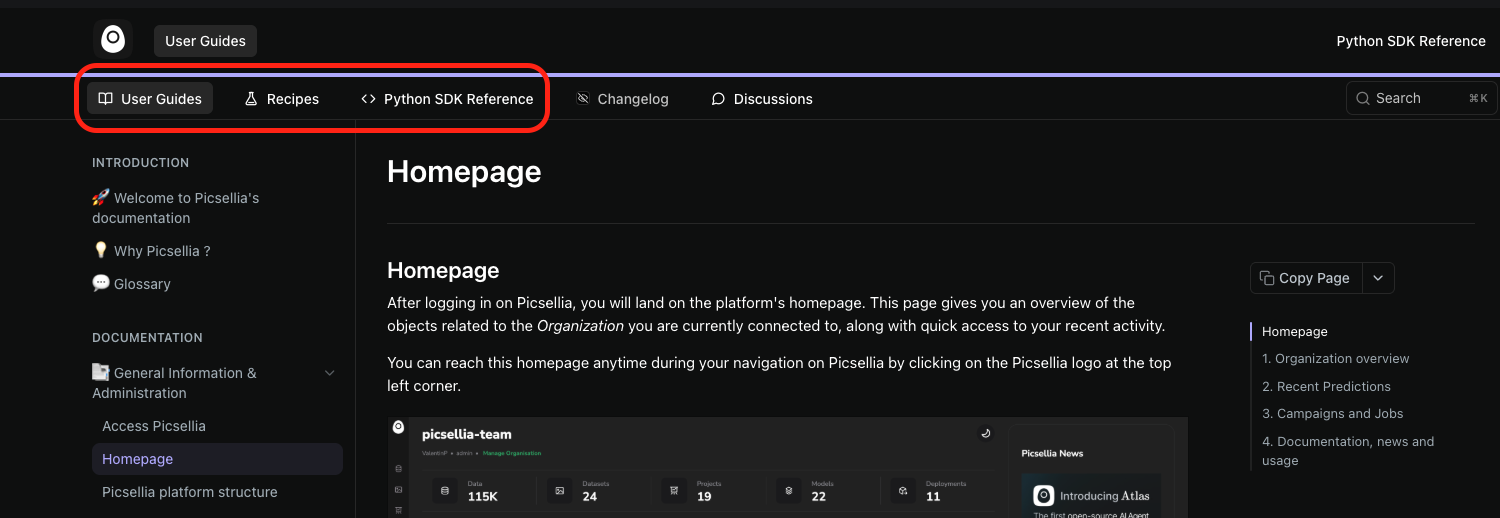
Documentation
To get started, take the tour of the platform, and keep the Glossary at hand for the objects you will meet along the way.
Updated 11 minutes ago